Solana Yield-Generating Tokens: Building a Portfolio for Passive Income (2026)
Solana Yield-Generating Tokens: Building a Portfolio for Passive Income (2026)
Staking SOL earns you 5-7% annually. But what if you could build a Solana portfolio that generates 10-20% in passive income while maintaining liquidity and managing risk? The key isn’t chasing the highest APY—it’s selecting the right mix of yield-generating tokens and allocating your portfolio strategically.
Yield-generating tokens like mSOL, jitoSOL, JUP, and RAY transform passive holdings into income-producing assets through staking rewards, protocol fees, and revenue sharing. But not all yield is equal. A token offering 30% APY with 80% volatility delivers worse risk-adjusted returns than one offering 8% APY with 15% volatility.
This comprehensive guide shows you how to identify legitimate yield-generating Solana tokens, evaluate their risk-return profiles, and build a diversified portfolio that generates sustainable passive income. You’ll learn which tokens to hold, how much to allocate to each category, and how to manage the unique risks of yield-focused investing.
What Are Yield-Generating Tokens?
DEFINITION: Yield-generating tokens are cryptocurrencies that provide passive income to holders through protocol revenue sharing, staking rewards, liquidity provision fees, or token emissions. Unlike speculative tokens that only appreciate through price increase, yield-generating tokens distribute value directly to holders, creating cash flow similar to dividend stocks or bonds.
Related terms: Liquid staking derivatives (LSDs), DeFi protocol tokens, revenue-sharing tokens, staking tokens, yield farming
Synonyms: Income-generating tokens, cash-flow tokens, productive assets, yield-bearing tokens
How Yield-Generating Tokens Work
Yield-generating tokens produce income through several mechanisms:
- Staking Rewards: Tokens like mSOL and jitoSOL represent staked SOL that earns validator rewards. Holders receive ~5-7% annual yield from network inflation and transaction fees.
- Protocol Revenue Sharing: DeFi tokens like JUP and RAY distribute a portion of protocol trading fees to token holders or stakers.
- Liquidity Provider Fees: LP tokens from Raydium, Orca, or Meteora earn trading fees from users swapping tokens in liquidity pools.
- Lending Interest: Supplying tokens to lending protocols (Kamino, MarginFi) earns interest from borrowers.
- Token Emissions: Some protocols distribute additional tokens as rewards to incentivize liquidity and usage.
KEY INSIGHT: Sustainable yield comes from real revenue (fees, staking rewards, interest). Unsustainable yield comes from token emissions that dilute holders. A protocol paying 50% APY from printing tokens is not generating real yield—it’s a ponzi scheme waiting to collapse.
Categories of Yield-Generating Solana Tokens
Understanding token categories helps you build a balanced portfolio with appropriate risk-return characteristics.
Category 1: Liquid Staking Tokens (Lowest Risk)
What they are: Tokens representing staked SOL that can be traded while still earning staking rewards.
Major tokens:
- mSOL (Marinade): Largest liquid staking protocol, ~$1.5B TVL, 5.5-6.5% APY
- jitoSOL (Jito): MEV-enhanced staking, ~$2B TVL, 6-7% APY (includes MEV rewards)
- bSOL (BlazeStake): Smaller but competitive, ~$100M TVL, 5-6% APY
Yield source: Solana network staking rewards + MEV (for Jito)
Risk profile:
- Smart contract risk: Low (audited, battle-tested)
- Price volatility: Tracks SOL price closely
- Liquidity: High (can trade on major DEXs)
- Yield stability: Very stable, tied to network inflation
Best for: Conservative investors, core portfolio holdings, long-term holders
Category 2: DeFi Protocol Tokens (Moderate Risk)
What they are: Governance tokens of DeFi protocols that may distribute trading fees or protocol revenue.
Major tokens:
- JUP (Jupiter): Leading DEX aggregator, potential fee sharing model, high liquidity
- RAY (Raydium): AMM DEX, stakers earn trading fees, ~$500M TVL
- DRIFT (Drift Protocol): Perpetuals exchange, revenue sharing for stakers
- ORCA (Orca): User-friendly AMM, concentrated liquidity, fee distribution
Yield source: Trading fees, protocol revenue sharing (varies by protocol)
Risk profile:
- Smart contract risk: Moderate (protocols are mature but complex)
- Price volatility: High (token price fluctuates with DeFi sentiment)
- Liquidity: Moderate to high
- Yield stability: Variable (depends on protocol usage and trading volume)
Best for: Moderate risk tolerance, DeFi-native investors, active portfolio management
Category 3: Lending Protocol Tokens (Moderate-High Risk)
What they are: Tokens that can be supplied to lending protocols to earn interest from borrowers.
Major protocols:
- Kamino Finance: Automated liquidity and lending, leveraged yield strategies
- MarginFi: Decentralized lending, competitive rates
- Solend: Established lending protocol, algorithmic interest rates
Yield source: Interest from borrowers + protocol token emissions
Risk profile:
- Smart contract risk: Moderate-high (complex protocols, liquidation mechanisms)
- Price volatility: Depends on supplied token
- Liquidity: Can vary (withdrawal may require waiting for available liquidity)
- Yield stability: Fluctuates with utilization rates
- Liquidation risk: If borrowing against supplied collateral
Best for: Experienced DeFi users, those comfortable with protocol complexity
Category 4: Liquidity Pool (LP) Tokens (High Risk)
What they are: Tokens representing your share of a liquidity pool on a DEX.
Major protocols:
- Raydium LP tokens: Earn trading fees from swaps
- Orca LP tokens: Concentrated liquidity positions
- Meteora DLMM: Dynamic liquidity market maker
Yield source: Trading fees from pool activity + potential token emissions
Risk profile:
- Smart contract risk: Moderate
- Price volatility: Exposed to both tokens in pair
- Impermanent loss: Can lose value vs holding tokens separately
- Liquidity: Generally good (can exit anytime)
- Yield stability: Varies with trading volume
Best for: Advanced users who understand impermanent loss, high risk tolerance
In Summary: Liquid staking tokens offer the lowest risk and most predictable yield. DeFi protocol tokens add moderate risk for potentially higher returns. Lending and LP tokens carry the highest risk but may offer the highest yields. A balanced portfolio combines multiple categories.
📊 Optimize Your Portfolio Allocation
Wondering how much to allocate to each token? Get data-driven recommendations for optimal allocation across your holdings.
Professional Portfolio Analysis:
✓ Markowitz optimization for any SPL tokens
✓ Risk-adjusted allocation recommendations
✓ Works with mSOL, jitoSOL, JUP, RAY, and more
Risk-Adjusted Yield Analysis
Raw APY numbers are misleading. A 50% APY token that drops 60% in price nets you -10% returns. Risk-adjusted yield accounts for volatility, risk, and total returns.
Real Yield vs Nominal Yield
Nominal yield: The advertised APY number
Real yield: Nominal yield – token price change – inflation
Example:
- Token A: 30% APY, but token price drops 40% → Real return: -10%
- Token B: 6% APY, token price rises 20% → Real return: +26%
Token B delivered better returns despite lower yield. This is why evaluating the underlying token’s fundamentals and price stability matters.
Sustainable vs Unsustainable Yields
Sustainable yields come from real revenue:
- Staking rewards from network inflation (Solana’s ~5-7%)
- Trading fees distributed to holders (Raydium, Orca)
- Interest from borrowers (lending protocols)
- Protocol revenue sharing (Jupiter, Drift)
Unsustainable yields come from:
- High token emissions (dilutes existing holders)
- Subsidized incentives (protocol burning cash to attract users)
- Ponzi mechanics (new deposits fund old withdrawals)
Red flags for unsustainable yield:
- APY >50% on established, large-cap tokens
- No clear revenue source (protocol has no fees or usage)
- Token emissions rate >20% annually
- TVL declining while APY increasing (exit spiral)
- Protocol launched <30 days ago with high APY
Risk-Return Comparison Table
| Token Category | Typical APY | Volatility | Risk Score | Sharpe Estimate |
|---|---|---|---|---|
| Liquid Staking (mSOL, jitoSOL) | 5-7% | Low (tracks SOL) | 2/5 | 0.8-1.2 |
| Established DeFi (JUP, RAY) | 5-15% | High | 3/5 | 0.5-0.9 |
| Lending Protocols | 3-20% | Moderate-High | 4/5 | 0.3-0.7 |
| LP Tokens (Stable pairs) | 10-30% | Low (stablecoin pairs) | 3/5 | 0.6-1.0 |
| LP Tokens (Volatile pairs) | 20-50% | Very High | 5/5 | 0.2-0.5 |
| New DeFi Protocols | 50-200% | Extreme | 5/5 | 0.1-0.3 |
KEY INSIGHT: Liquid staking tokens often deliver the best risk-adjusted returns (highest Sharpe ratio) despite lower nominal yield. They offer predictable income with minimal downside risk. Higher APY tokens rarely compensate for their dramatically higher volatility and risk.
📉 Check Your Portfolio Risk Profile
High yield means nothing if your portfolio is too risky. See if your allocation matches your risk tolerance.
Calculate key risk metrics:
- 📊 Portfolio volatility (standard deviation)
- 📈 Sharpe ratio (risk-adjusted returns)
- 📉 Maximum drawdown (worst-case loss)
- 🎯 Sortino ratio (downside risk)
Free analysis • Instant results • Professional-grade metrics
Portfolio Allocation Strategies for Yield
How you allocate across yield-generating token categories determines your risk-return profile.
Strategy 1: Conservative Income Portfolio
Target yield: 5-8% annually
Risk level: Low
Volatility: Similar to holding SOL
Allocation:
- 60% Liquid staking (40% mSOL, 20% jitoSOL)
- 20% SOL (unliquid reserve)
- 15% Stablecoins (USDC)
- 5% Established DeFi (JUP or RAY)
Characteristics:
- Highly liquid (can exit anytime)
- Minimal smart contract risk
- Predictable yield from staking
- Low maintenance (rebalance quarterly)
Best for: Risk-averse investors, passive income seekers, retirement portfolios, capital preservation focus
Strategy 2: Moderate Yield Portfolio
Target yield: 8-15% annually
Risk level: Moderate
Volatility: Moderate-high
Allocation:
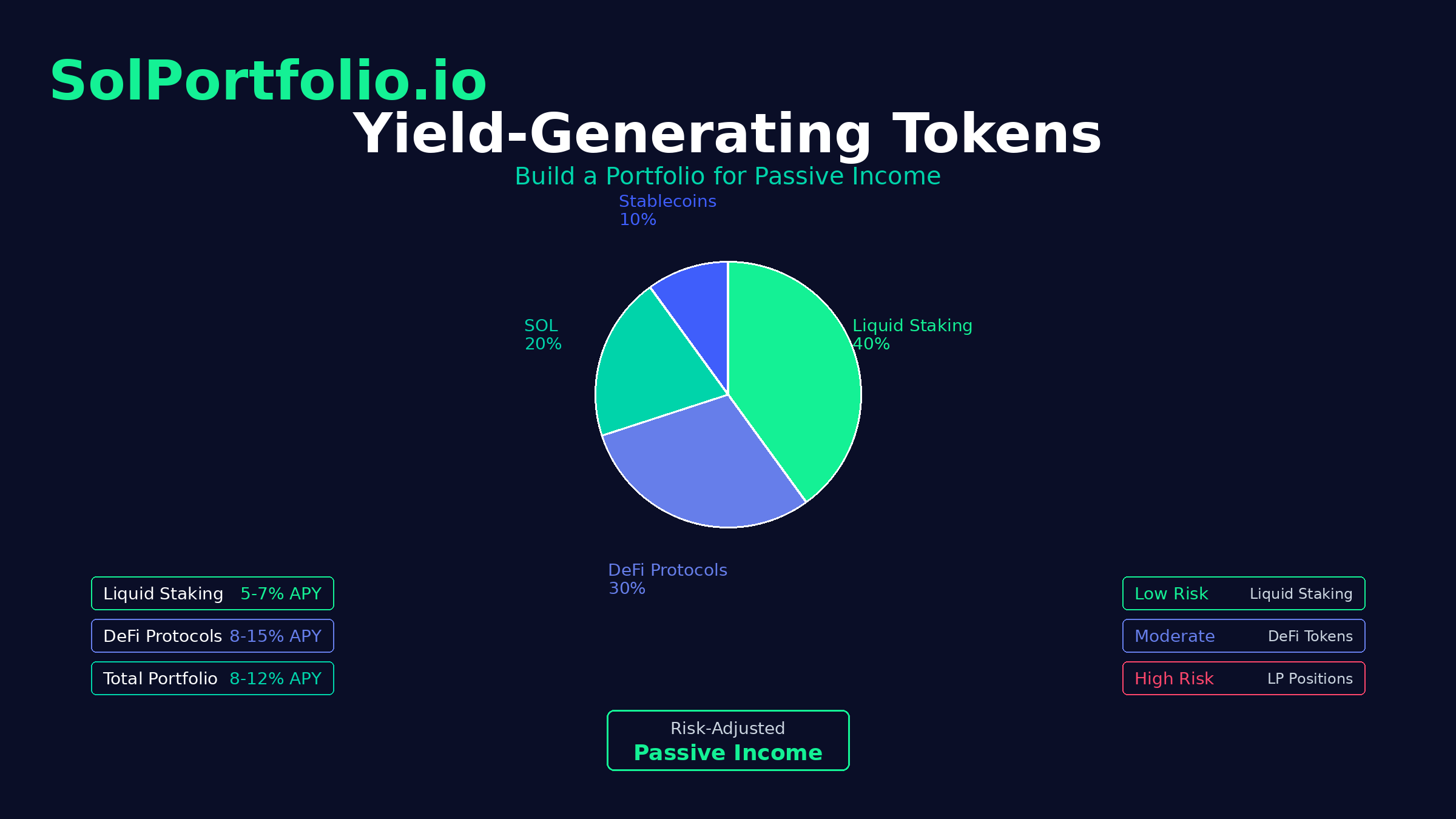
- 40% Liquid staking (25% jitoSOL, 15% mSOL)
- 30% DeFi protocols (15% JUP, 10% RAY, 5% DRIFT)
- 15% SOL
- 10% Stablecoins (USDC)
- 5% Lending protocols (Kamino or MarginFi)
Characteristics:
- Diversified across multiple yield sources
- Mix of stable and variable yields
- Requires monthly monitoring
- Higher returns with manageable risk
Best for: Most investors, balanced risk-return, active portfolio managers
Strategy 3: Aggressive Yield Portfolio
Target yield: 15-30% annually
Risk level: High
Volatility: Very high
Allocation:
- 30% Liquid staking (20% jitoSOL, 10% mSOL)
- 30% DeFi protocols (10% JUP, 10% RAY, 10% DRIFT)
- 20% Lending protocols (Kamino, MarginFi)
- 10% LP tokens (stable pairs on Orca/Raydium)
- 10% SOL or stablecoins (reserve)
Characteristics:
- Maximum yield extraction
- Multiple protocol exposures
- Requires weekly monitoring
- Significant impermanent loss risk (LP positions)
- Higher smart contract risk
Best for: Experienced DeFi users, high risk tolerance, active management, those who can monitor daily
Sample Portfolio Comparison
| Strategy | Expected Yield | Annual Volatility | Max Drawdown | Sharpe Ratio |
|---|---|---|---|---|
| Conservative | 6% | 35% | -25% | 1.1 |
| Moderate | 12% | 55% | -40% | 0.8 |
| Aggressive | 22% | 80% | -60% | 0.6 |
Analysis: The conservative portfolio delivers the best risk-adjusted returns (highest Sharpe ratio). While aggressive portfolios offer higher nominal yield, they expose you to much larger drawdowns during market corrections.
Comparing Top Yield-Generating Solana Tokens
Here’s a detailed comparison of major yield-generating tokens available on Solana:
| Token | Yield Type | Typical APY | Risk Level | Liquidity | TVL |
|---|---|---|---|---|---|
| mSOL | Liquid Staking | 5.5-6.5% | Low | High | $1.5B+ |
| jitoSOL | Liquid Staking + MEV | 6-7% | Low | High | $2B+ |
| bSOL | Liquid Staking | 5-6% | Low | Moderate | $100M+ |
| JUP | Protocol Token | Variable | Moderate | Very High | N/A |
| RAY | DEX Fees | 8-15% | Moderate | High | $500M+ |
| DRIFT | Perp Exchange | Variable | Moderate-High | Moderate | $200M+ |
| ORCA | DEX Fees | Variable | Moderate | High | $300M+ |
Data sources: APY rates and TVL data from DeFiLlama, accurate as of February 2026. Rates fluctuate based on network activity and protocol usage.
Understanding Correlation Between Yield Tokens
Most yield-generating tokens are highly correlated, which reduces true diversification benefits.
Correlation Patterns
High correlation (>0.8):
- All liquid staking tokens (mSOL, jitoSOL, bSOL) with SOL: 0.95+
- DeFi tokens with each other (JUP, RAY, ORCA, DRIFT): 0.75-0.85
- All DeFi tokens with general crypto market: 0.7+
Moderate correlation (0.5-0.8):
- Liquid staking tokens with DeFi protocols: 0.6-0.7
- Stablecoin LP tokens with volatile tokens: 0.4-0.6
Low correlation (<0.5):
- Stablecoins (USDC) with volatile tokens: 0.1-0.3
- Some specialized protocols with general DeFi: varies
Implications for Portfolio Construction
The problem: Holding mSOL, jitoSOL, bSOL, JUP, RAY, and DRIFT feels diversified (6 different tokens), but they’re all highly correlated. When Solana sentiment turns negative or DeFi crashes, everything drops together.
The solution: True diversification requires mixing asset classes:
- Liquid staking (correlated with SOL)
- DeFi protocols (correlated with DeFi sentiment)
- Stablecoins (uncorrelated with crypto markets)
- SOL itself (base layer)
- Potentially RWA or other uncorrelated Solana assets
How Modern Portfolio Theory helps: Markowitz optimization explicitly accounts for correlations between tokens. Instead of guessing which combinations provide diversification, mathematical optimization finds the allocation with maximum diversification benefit given historical correlations.
🔗 Are You Truly Diversified?
Most DeFi tokens move together. Check if your holdings provide actual diversification or just create correlated risk.
View your correlation matrix:
- 🔍 See which tokens move together
- ⚠️ Identify concentrated sector risk
- 🎯 Get better diversification suggestions
- 📊 Markowitz optimization for true diversification
Reduce correlated risk • Improve portfolio efficiency
Position Sizing for Yield Tokens
How much should you allocate to each yield-generating token? Position sizing determines your risk exposure.
General Position Sizing Rules
By risk category:
- Liquid staking tokens: 10-40% per token (low risk, can hold large positions)
- Established DeFi (JUP, RAY): 5-15% per token
- Newer DeFi protocols: 3-8% per token
- Lending protocol positions: 5-10% per protocol
- LP tokens: 2-5% per pool (due to impermanent loss risk)
- Experimental yield strategies: 1-3% maximum
Portfolio-level limits:
- Total liquid staking: 40-60% of portfolio maximum
- Total DeFi protocol tokens: 20-40% maximum
- Total lending positions: 15% maximum
- Total LP positions: 10% maximum
- Stablecoins/reserves: 10-20% minimum
Kelly Criterion for Yield Tokens
The Kelly Criterion can guide position sizing based on expected returns and volatility.
Simplified Kelly for crypto: Position size = Expected excess return / Volatility²
Example for liquid staking:
- Expected return: 6%
- Volatility: 50% (tracks SOL)
- Kelly = 6% / (50%)² = 6% / 0.25 = 24%
- Suggested position: 24% (or use Half Kelly = 12% for safety)
Example for high-yield DeFi:
- Expected return: 25%
- Volatility: 100%
- Kelly = 25% / (100%)² = 25% / 1.0 = 25%
- But high volatility means higher risk → Use Quarter Kelly = 6%
KEY INSIGHT: Kelly criterion shows why liquid staking deserves large allocations despite lower yield—the superior risk-return ratio justifies position size. High-yield tokens demand smaller positions because volatility squared grows faster than yield.
Rebalancing Yield-Focused Portfolios
Token prices change, yields fluctuate, and allocations drift. Systematic rebalancing maintains your target allocation.
When to Rebalance Yield Portfolios
Rebalancing triggers specific to yield investing:
- Allocation drift >20%: Standard rebalancing rule applies to yield tokens too
- Yield changes significantly: If a protocol’s APY drops 50%+ (may indicate problems)
- New superior options emerge: Better risk-adjusted yield becomes available
- Protocol risk increases: TVL drops >30%, exploit rumors, team departures
- Token price extreme moves: DeFi token rallies 200%+ (take profits)
Recommended frequency:
- Conservative portfolios (mostly liquid staking): Quarterly rebalancing
- Moderate portfolios (mix of categories): Monthly rebalancing
- Aggressive portfolios (LP positions, lending): Weekly monitoring, rebalance as needed
Yield Harvesting Strategy
Should you compound or take profits?
Compound (reinvest) when:
- You’re accumulating for long-term goals
- Token fundamentals remain strong
- You’re below target allocation for that token
- Tax efficiency: Delaying realization until long-term capital gains
Take profits when:
- You need the income (living expenses)
- Token is above target allocation
- Risk metrics deteriorating (Sharpe ratio declining)
- Better opportunities available elsewhere
Hybrid approach (recommended):
- Automatically compound yield on underweight positions
- Take profits on overweight positions
- This naturally rebalances your portfolio while maximizing compound growth on the right positions
Common Mistakes with Yield Tokens
Mistake #1: Chasing Highest APY Without Risk Assessment
The error: Seeing 80% APY and allocating 30% of portfolio without evaluating protocol risk or sustainability.
Why it’s wrong: High APY usually signals high risk, token emissions (dilution), or ponzi mechanics. The protocol may fail before you recover your principal.
Solution: Evaluate yield sustainability. Check: TVL trend, emission schedule, revenue sources, audit status, team track record. Never allocate >5% to any >50% APY opportunity.
Mistake #2: Over-Concentration in DeFi Protocol Tokens
The error: Portfolio is 60% DeFi tokens (JUP, RAY, DRIFT, ORCA). “I’m diversified across 4 different protocols!”
Why it’s wrong: All DeFi tokens are highly correlated (0.75-0.85). When DeFi sentiment turns or Solana has issues, all crash together. You have false diversification.
Solution: Limit total DeFi exposure to 30-40% maximum. Balance with liquid staking (different risk profile) and stablecoins (uncorrelated).
Mistake #3: Ignoring Impermanent Loss in LP Positions
The error: Providing liquidity to volatile pairs and only tracking APY, not total returns including impermanent loss.
Why it’s wrong: Impermanent loss can easily exceed yield earned. A 30% APY LP position can lose 40% to impermanent loss if token prices diverge, netting -10% total return.
Solution: Only provide liquidity to pairs where you believe price ratio will remain stable (stablecoin pairs, highly correlated tokens). Track total position value, not just earned fees.
Mistake #4: Not Accounting for Token Price Volatility
The error: “I earned 20% APY!” while token price dropped 50%, resulting in -30% total return.
Why it’s wrong: Yield is meaningless if the underlying token loses more value than the yield generates.
Solution: Calculate total returns = Yield + Price change. Prioritize tokens with strong fundamentals and price stability over high-yield, high-volatility tokens.
Mistake #5: Forgetting About Tax Drag on Yield
The error: Not accounting for taxes on staking rewards, reducing actual returns.
Why it’s wrong: Staking rewards are taxed as ordinary income when received. In high tax jurisdictions, this can reduce 6% yield to 3.6% post-tax.
Solution: Calculate after-tax yield. In some cases, lower-yield but tax-advantaged strategies (holding for long-term capital gains) beat high-yield taxable income.
Mistake #6: Using Leverage on Yield Positions
The error: Borrowing against mSOL or other yield tokens to buy more, creating leverage.
Why it’s wrong: Leverage amplifies losses. A 30% market drop with 2x leverage = 60% loss. Liquidation risk destroys capital permanently. The 6% yield doesn’t compensate for liquidation risk.
Solution: Avoid leverage on yield strategies unless you’re highly experienced. If using leverage, never exceed 1.5x, set strict stop-losses, monitor liquidation price daily.
Mistake #7: No Exit Strategy for Illiquid Yield Tokens
The error: Allocating 20% to a low-liquidity yield token with only $2M daily volume.
Why it’s wrong: When you need to exit (protocol issues, market crash), slippage will be 10-20%. You’re effectively trapped.
Solution: Limit illiquid yield positions to 5% portfolio maximum. Ensure your position is <10% of daily trading volume for any token.
Tax Implications of Yield-Generating Tokens
Yield from crypto is taxable. Understanding tax treatment helps optimize net returns.
How Crypto Yield is Taxed
In most jurisdictions including the United States, crypto yield is taxed as ordinary income when received. Guidance from the IRS on digital assets clarifies the tax treatment.
Staking rewards:
- Taxed as ordinary income when received
- Value = fair market value at time of receipt
- Tax rate: Your marginal income tax rate (10-37% federal in US)
- Additional state/local taxes may apply
DeFi yield (fees, revenue sharing):
- Taxed as ordinary income when received or claimed
- Each harvest/claim is a taxable event
- Must track every transaction for reporting
LP fees:
- Tax treatment debated (IRS hasn’t clarified)
- Conservative approach: Income when earned
- Aggressive approach: Not income until position closed
- Consult tax professional for your situation
Tax Optimization Strategies
1. Tax-loss harvesting with yield tokens
If DeFi token is down, sell to realize loss (offsets other gains), then rebuy after 30 days to avoid wash sale rules (note: wash sale rules may not apply to crypto, but be cautious).
2. Strategic timing of yield claims
Claim yield in low-income years to minimize marginal tax rate. If expecting lower income next year, defer claiming until then.
3. Hold for long-term capital gains
Yield itself is ordinary income, but token appreciation qualifies for long-term capital gains (lower rate) if held >1 year. This favors lower-yield, higher-appreciation tokens.
4. Consider tax-advantaged accounts
If your jurisdiction allows crypto in IRAs or similar accounts, yield grows tax-deferred. Ideal for long-term yield strategies.
Record Keeping Requirements
Maintain detailed records of:
- Date and amount of each yield payment received
- Fair market value in USD at time of receipt
- Token acquired (if auto-compounding)
- Cost basis of tokens sold or traded
- Transaction fees paid
Tools: CoinTracker, Koinly, TokenTax automatically track Solana transactions and generate tax reports.
Frequently Asked Questions
Q: What’s the safest yield-generating Solana token?
The Answer: Liquid staking tokens like mSOL and jitoSOL are the safest yield options. They’re backed by actual staked SOL, earn predictable network rewards (5-7% APY), have been audited by multiple firms, and maintain high liquidity. Risk comes only from smart contract exploits (low probability) and SOL price volatility (but you’d have that risk holding SOL anyway). For absolute safety, jitoSOL and mSOL are battle-tested with billions in TVL.
Q: How much of my portfolio should be in yield-generating tokens?
In Brief: It depends on your goals. For pure capital appreciation, 0-20% in yield tokens. For balanced growth + income, 30-50% in yield tokens (mostly liquid staking). For income focus, 60-80% in yield tokens with emphasis on safe, predictable yields. Most investors benefit from 30-50% allocation: enough to generate meaningful income without sacrificing too much growth potential.
Q: Do yield-generating tokens qualify for long-term capital gains?
The Answer: The yield itself (staking rewards, protocol fees) is taxed as ordinary income when received. However, price appreciation on the underlying token qualifies for long-term capital gains if held >1 year. Example: You buy mSOL at $100, earn 6% staking rewards (taxed as income), then sell mSOL at $120 after 1 year. The $20 price gain qualifies for long-term capital gains rate (lower than ordinary income). Always consult a tax professional for your specific situation.
Q: Should I reinvest yields or take profits?
In Brief: Reinvest (compound) if you’re accumulating wealth and token fundamentals are strong. This maximizes long-term compound growth. Take profits if you need income, token is overweight in your portfolio, or risk metrics are deteriorating. Hybrid approach works best: compound yield on underweight positions, take profits on overweight positions—this naturally rebalances while maximizing growth.
Q: What’s a sustainable yield for Solana DeFi?
The Answer: Sustainable yields come from real revenue. For Solana: Liquid staking (5-7%) is sustainable from network inflation. DeFi protocols earning trading fees can sustainably offer 8-15% if protocol has real usage and volume. Lending protocols offering 10-20% are sustainable if funded by actual borrower interest. Anything above 30% APY on established tokens requires scrutiny—likely subsidized or unsustainable. New protocols offering 50-200% are almost always temporary incentives that will decline rapidly.
Q: How do I calculate risk-adjusted yield?
In Brief: Use the Sharpe ratio: (Yield + Price return – Risk-free rate) / Volatility. Higher Sharpe = better risk-adjusted returns. Example: Token A with 6% yield and 40% volatility has Sharpe ~0.15. Token B with 15% yield and 100% volatility has Sharpe ~0.15. They’re equal on risk-adjusted basis. Also calculate: Real return = Nominal yield + Price change – Inflation. A 10% yield with -20% price change = -10% real return.
Q: Are liquid staking tokens safe?
The Answer: Liquid staking tokens (mSOL, jitoSOL) are among the safest DeFi products. Risks: (1) Smart contract exploit (low—protocols are audited and battle-tested with billions in TVL), (2) Validator slashing (minimal—diversified across many validators), (3) Depegging (rare—high liquidity maintains tight peg to SOL). Overall, liquid staking is safer than most DeFi alternatives and only slightly riskier than holding SOL directly in a wallet. For conservative investors, they’re the safest way to earn yield.
Q: How often should I rebalance a yield-focused portfolio?
In Brief: Check monthly, rebalance when any position drifts >20% from target allocation. Conservative portfolios (mostly liquid staking): quarterly rebalancing is sufficient. Moderate portfolios (mixed categories): monthly rebalancing recommended. Aggressive portfolios (lending, LP positions): weekly monitoring with rebalancing as needed. Also rebalance immediately if protocol risk increases (TVL drop, exploit rumors, yield crash) regardless of schedule.
📊 Build a Properly Optimized Portfolio
Whether holding liquid staking tokens, DeFi protocols, or any SPL tokens—optimize your allocation with professional analytics.
✓ No credit card required • ✓ Connect wallet in 30 seconds • ✓ Free analysis
Conclusion: Sustainable Income Through Smart Allocation
Yield-generating tokens offer Solana investors the opportunity to earn 5-30% annual passive income. But not all yield is created equal. Sustainable income comes from strategic allocation across token categories, rigorous risk management, and focus on real revenue rather than unsustainable token emissions.
Key principles for yield success:
- Prioritize risk-adjusted returns over raw APY: 6% from liquid staking beats 30% from a protocol that might fail
- Diversify across yield categories: Mix liquid staking, DeFi protocols, and stablecoins—don’t over-concentrate in DeFi
- Position sizing matters: Larger positions in safe yield (liquid staking), smaller positions in risky yield (new protocols)
- Monitor and rebalance regularly: Yields change, risks evolve, allocations drift
- Account for taxes: After-tax returns are what matter, not headline APY
- Avoid common mistakes: Don’t chase yield, use leverage, or ignore impermanent loss
The path forward:
- Assess your risk tolerance and income needs
- Choose appropriate allocation strategy (conservative, moderate, or aggressive)
- Start with safe yield (liquid staking) as core holding
- Gradually add DeFi protocol tokens for higher yield
- Monitor protocol health and yields monthly
- Rebalance systematically when allocation drifts
- Track total returns (yield + price change), not just APY
- Maintain detailed tax records
Building a yield-focused Solana portfolio isn’t about finding the highest APY—it’s about constructing a balanced allocation that generates sustainable income while managing risk effectively. Liquid staking provides the foundation with safe, predictable yield. DeFi protocols add higher returns for moderate additional risk. Stablecoins provide diversification and dry powder.
The Solana ecosystem offers unprecedented yield opportunities. With disciplined allocation, regular rebalancing, and focus on risk-adjusted returns, you can build a portfolio that generates meaningful passive income year after year.
Start building your yield-optimized portfolio today. Compound growth from sustainable yield is one of crypto’s most powerful wealth-building tools.
About SolPortfolio.io
SolPortfolio.io provides professional portfolio optimization and risk analytics for Solana investors. Whether you’re holding liquid staking tokens, DeFi protocols, or any SPL tokens, connect your wallet to instantly analyze your allocation, calculate risk metrics (volatility, Sharpe ratio, correlation matrix), and get Markowitz-optimized recommendations. Built by quantitative finance professionals, SolPortfolio.io helps you build better-diversified portfolios with superior risk-adjusted returns.
Disclaimer: This article is for informational and educational purposes only and does not constitute financial, investment, or tax advice. Cryptocurrency investments carry substantial risk including potential loss of principal. DeFi protocols carry additional risks including smart contract exploits, impermanent loss, and protocol failure. Yields are not guaranteed and fluctuate based on market conditions. Past performance does not guarantee future results. Tax treatment varies by jurisdiction. Always conduct your own research and consider consulting with licensed financial and tax professionals before making investment decisions. Only invest capital you can afford to lose entirely.